
Do Exosomes Help With Hair Loss?
Where Exosomes Fit Inside the HMI Regenerative Blueprint
Exosomes are one of the most talked-about treatments in hair restoration right now.
But the real question isn’t just:
“Do exosomes help with hair loss?”
The better question is:
Where do exosomes fit inside a serious, long-term hair restoration plan?

At Hair Medicine Institute, we think of hair loss therapy in layers.
- Not hype.
- Not trends.
- But biology.
And exosomes may have a role — when used correctly.
The HMI Regenerative Blueprint: Stabilize First, Then Stimulate
Before we look at the exosome data, it’s important to understand something foundational:
Hair loss in most men (and many women) is driven by DHT-mediated miniaturization.
If DHT is not controlled:
- Miniaturization continues
- Regenerative therapies have diminishing returns
- Gains are temporary
That’s why in the HMI Blueprint, we prioritize:
Phase 1: Stabilization
- DHT modulation (finasteride, dutasteride, topical options)
- Minoxidil when appropriate
- Scalp optimization
Phase 2: Regenerative Stimulation
- Microneedling
- Laser therapy
- PRP
- Exosomes (select cases)
Exosomes are not a replacement for stabilization.
They are an amplifier.
Now let’s look at the actual data.
The 2025 JDD Study: Exosomes + Microneedling
A 2025 study in the Journal of Drugs in Dermatology evaluated an Exosome Regenerative Complex combined with RF microneedling in 30 subjects (15 men, 15 women) with thinning hair.
Treatments occurred at:
- Day 0
- Day 30
- Day 60
- Day 90
Final assessment at Day 120.
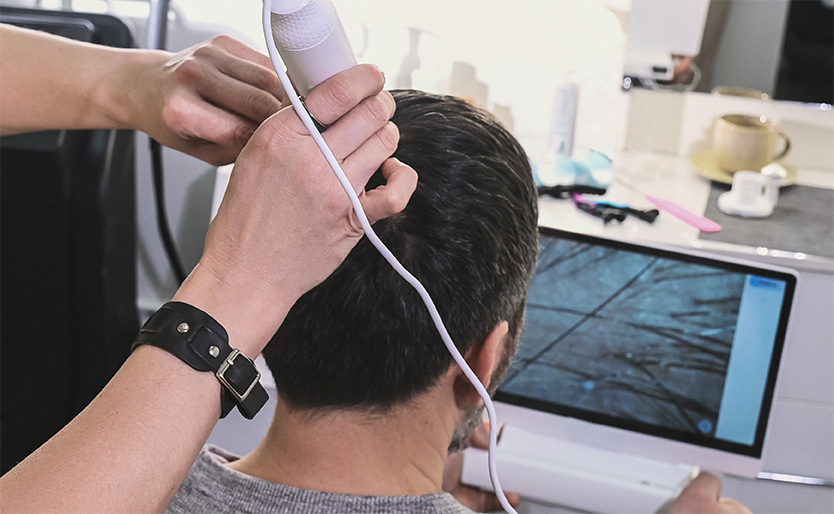
Digital trichoscopy (Canfield HairMetrix) was used to measure objective hair counts.
Do Exosomes Increase Hair Counts?
Yes — in this study, they did.
Terminal Hair Counts (Thicker, Cosmetic Hairs)
Anterior Scalp
- Baseline: 116.7 hairs
- Day 120: 157.8 hairs
- Increase: +41.1 hairs
- P < 0.0001
Posterior Scalp
- Baseline: 128.0 hairs
- Day 120: 175.0 hairs
- Increase: +47.0 hairs
- P < 0.0001
That is a meaningful change over four months.
Follicular Density Improvements
Increase in follicular units per cm² at Day 120:
- Anterior: +29.76 units/cm²
- Posterior: +16.69 units/cm²
- P < 0.0001
Inter-follicular distance decreased:
- Anterior: −0.13 mm
- Posterior: −0.10 mm
This suggests improved density, not just thicker strands.
Hair Shaft Thickness
Anterior hair width increased by:
- +2.65 microns
- P < 0.05
Hair Shedding
Hair pull testing demonstrated significant decreases in shedding at Day 120.
That matters.
Regeneration without stabilization often increases shedding first.
Here we saw the opposite.
But Here’s the Critical Question
Was it the exosomes?
Or the microneedling?
This was combination therapy.
Microneedling alone has been shown to stimulate hair growth through:
- Wound healing cascades
- Growth factor upregulation
- Improved topical penetration
So we cannot attribute all gains purely to exosomes.
But the magnitude of increase suggests a biologically active synergy.
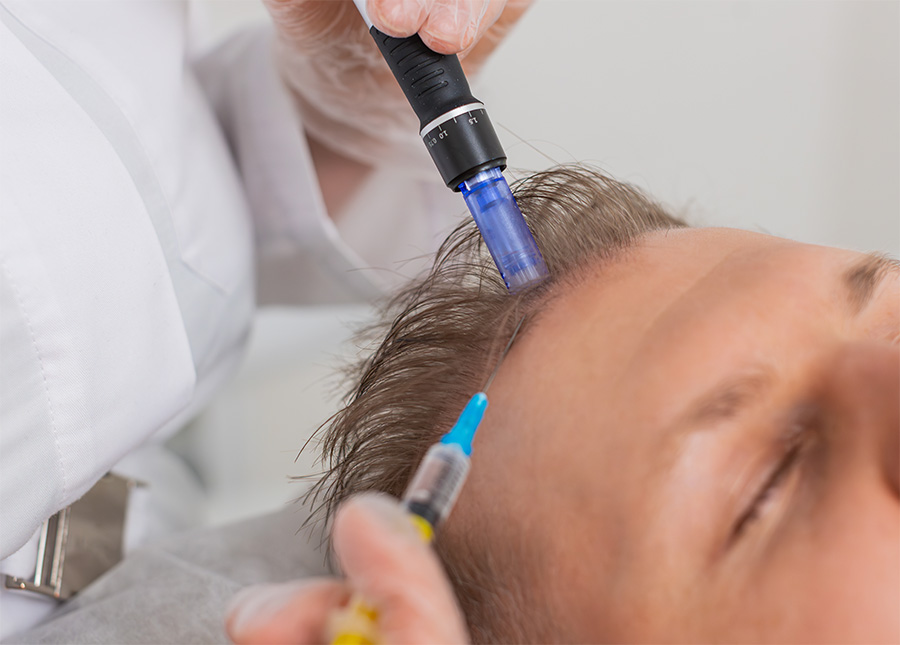
Where Exosomes Fit in the HMI Regenerative Blueprint
At HMI, we view exosomes as:
An Adjunctive Regenerative Accelerator
They may be particularly useful in:
- Early miniaturization
- Diffuse thinning
- Patients already stabilized on DHT suppression
- Post-transplant optimization
- Patients who want biologic stimulation beyond standard therapy
They are not:
- A substitute for DHT blockade
- A replacement for transplant in advanced loss
- A standalone solution for aggressive AGA
Inside the Blueprint, exosomes are a multiplier.
But only if the foundation is strong.
Safety Profile
In this study:
- No treatment-related adverse events were reported
- No systemic complications
- High patient satisfaction (100% satisfied or very satisfied)
That’s encouraging.
But larger randomized controlled trials are still needed.
So… Do Exosomes Help With Hair Loss?
The honest answer:
Yes — when combined with microneedling, they were associated with significant increases in terminal hair counts and follicular density over 120 days.
But they are most effective when layered onto a stabilized biological foundation.
At HMI, we don’t chase trends.
We integrate them strategically.
Exosomes may be a powerful tool.
But tools only work when used in the right blueprint.
Frequently Asked Questions
Are exosomes effective for hair loss?
Early clinical data suggests they may increase hair counts when combined with microneedling.
Are exosomes better than PRP?
We do not yet have high-quality head-to-head trials.
Do exosomes replace finasteride?
No. DHT suppression remains foundational in androgenetic alopecia.
Are exosome treatments safe?
This study reported no treatment-related adverse events, but long-term data is limited.