
Hair Transplant Surgery
Dr. Hawkins offers his patients both FUE and FUT hair transplant methods of donor harvesting.

Hair Restoration Surgery - Atlanta, GA
Hair transplant surgery involves moving hair from the sides and back of the scalp, where hair is thick (the donor site), to areas that are thinning or bald (the recipient site). It’s most often used to treat male or female pattern baldness, but it can also restore hair to eyebrows, beards, and scars caused by injury or surgery.
Consultation and Planning
Before your surgery, Dr. Hawkins will perform a comprehensive scalp and health examination. He will examine the scalp to assess hair loss pattern and donor hair density. He will discuss medical and surgical alternatives, as well as realistic goals and expected results.
If surgery is determined, he will review the number of grafts needed, donor-harvesting methods (including FUT and FUE), recovery time, and costs.
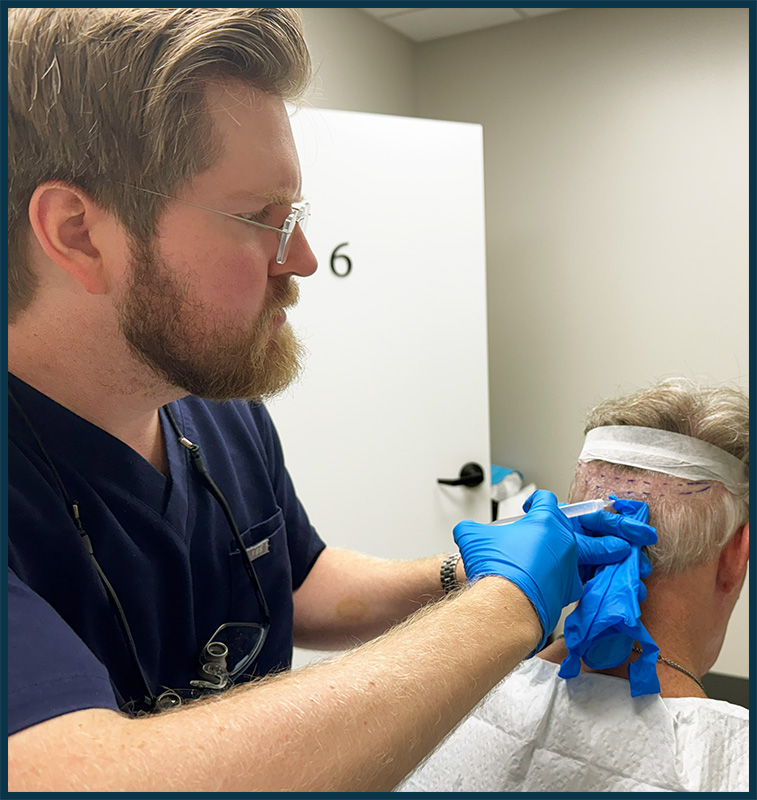
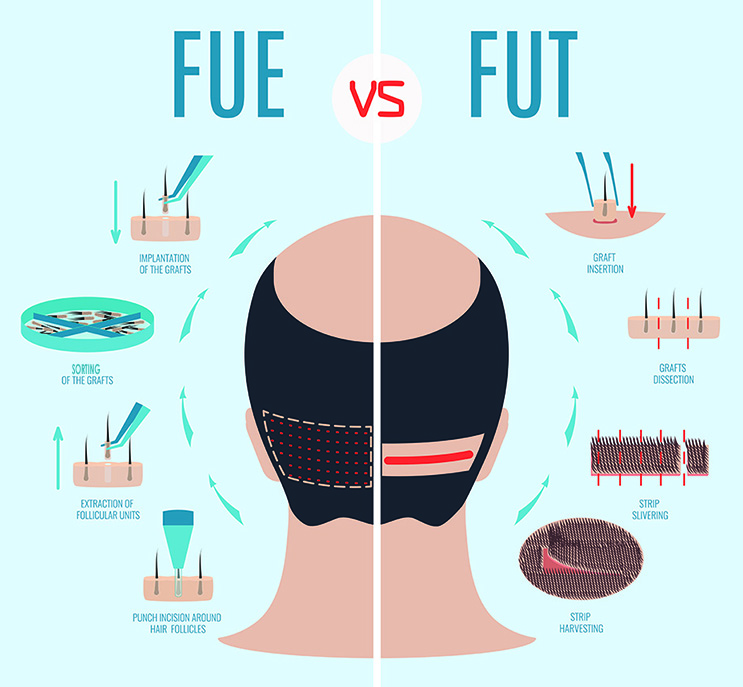
There are two main techniques for harvesting the donor hair:
FUT (Follicular Unit Transplantation / Strip Method)
- A thin strip of scalp with healthy hair follicles is surgically removed, from the back of the head.
- The strip is then dissected under a microscope into tiny grafts containing 1–4 hairs each.
- Dr. Hawkins will then close the donor area using advanced trichophytic to assure a fine linear scar that is hidden by surrounding hair.
FUE (Follicular Unit Excision / Extraction)
- With this method the doctor will extract individual hair follicles one by one using a small circular punch (typically 0.8–1.0 mm).
- This method leaves tiny dot scars that are usually invisible with even short hair styles and usually heal faster.
Most patients can return to normal activities within 1–3 days. Small scabs will form around grafts and fall off within about a week. The transplanted hairs usually shed after 2–4 weeks (this is normal) before regrowing permanently in about 3–4 months, with full results visible by 9–12 months. Because the transplanted follicles are resistant to the hormone (DHT) that causes pattern baldness, the results are typically permanent.