
The “Empty Follicle” Problem: Why Hair Loss Treatments Fail to Restore Density
If you’ve been dealing with hair loss for a while, you’ve probably heard the usual explanations: hair growth cycles, shedding phases, and miniaturization. Most discussions focus on whether hairs are growing or resting.
But there is a critical phase of hair loss that is rarely discussed, even in many dermatology offices—and it’s often the reason density doesn’t return.
That phase is called kenogen.
Most patients I see are doing “everything right”—taking medications, using topicals, even undergoing in-office treatments—yet they remain frustrated by how their hair looks.
When I examine their scalp, I’m not just evaluating thinning hairs.
I’m looking for empty follicles.
Why Shedding Isn’t the Same as Hair Loss
Shedding is normal. Everyone sheds hair every day, including people with thick, healthy hair.
The real issue begins after a hair sheds.
In a healthy scalp, when a hair falls out, the follicle immediately begins producing a replacement. Hair cycling is continuous, and density is preserved.
In pattern hair loss, that relay often breaks down.
The hair sheds—but the follicle fails to produce a new hair in its place.
The follicle isn’t dead. It still has stem cells. It still has blood supply. But it becomes inactive.

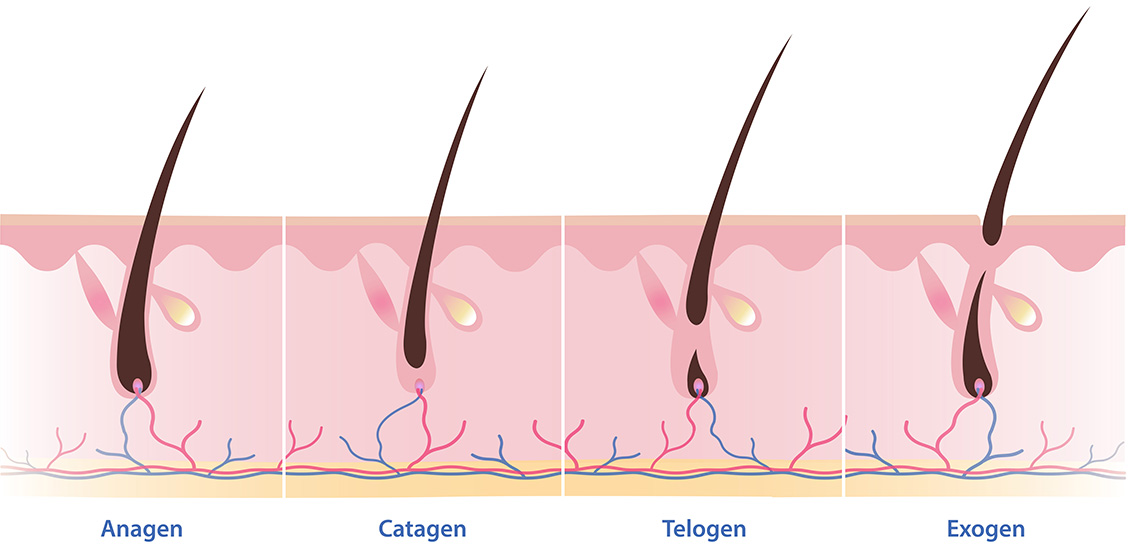
Traditional hair growth cycle.
This prolonged empty state is called kenogen.
Kenogen describes a follicle that is still present and biologically alive, but no longer producing visible hair. When enough follicles enter this state, hair loss stops looking like “thinning” and starts looking like missing density.
This distinction is critical—and rarely explained.
Kenogen: The Hidden Driver of Density Loss
In androgenetic alopecia (pattern hair loss), kenogen becomes increasingly common.
Studies suggest that in thinning scalps, 20–30% of follicles may be trapped in this empty, inactive phase. That means a significant portion of follicles are not miniaturized—they’re simply offline.
This explains a common experience I hear from patients:
“I’m shedding less, but my hair still isn’t coming back.”
Reducing shedding helps preserve what’s there.
It does not necessarily reactivate follicles that are already empty.

Why Medications Alone Often Plateau
Medications like finasteride and minoxidil are extremely effective at slowing hair loss and preserving existing hair, and they remain foundational in evidence-based treatment.
However, their primary role is protection—not reactivation.
They help prevent follicles from miniaturizing further, but they are often insufficient to wake up follicles that have been sitting in prolonged kenogen.
This is why many patients plateau:
the hair that’s still growing is protected, but empty follicles remain empty.
Why “Once-a-Month” Treatments Often Fall Short
Many in-office hair treatments are offered on a monthly schedule. While convenient, this approach often fails to match follicular biology—especially when kenogen is present.
When follicles are stimulated, growth signals are activated that encourage them to re-enter the growth phase. These signals, however, are temporary.
If stimulation is too infrequent, follicles may briefly activate and then drift back toward inactivity before meaningful growth occurs. For follicles trapped in kenogen, this start-stop pattern often fails to produce visible density.
Dormant follicles don’t need occasional stimulation.
They need consistent signaling over time.
A Biology-First Philosophy: The HMI Regenerative Blueprint
At Hair Medicine Institute, we approach hair restoration based on follicular physiology, not generic schedules.
I often explain it this way: waking up a dormant follicle is like launching a rocket. It takes concentrated effort to get off the ground. Once stability is achieved, the intensity can be reduced.
That philosophy underlies the HMI Regenerative Blueprint—a phased, biology-driven approach designed to address kenogen first, then transition toward long-term preservation.
A Phased Framework for Hair Regeneration
Rather than offering isolated treatments, our approach follows three biological phases:
Induction
An intentionally more intensive early phase designed to prevent growth signaling from dropping off while inactive follicles are being reactivated.
Transition
As follicles begin producing new hairs, the focus shifts toward supporting metabolic demand and structural maturation.
Maintenance
Once follicles are cycling normally again, treatment frequency is reduced. The goal becomes preservation—maintaining scalp health and protecting gains while medical therapy continues at home.
What Realistic Results Actually Look Like
I’m very direct with my patients about timelines.
When a follicle comes out of kenogen, it does not immediately produce a thick, terminal hair. Most often, it first produces a finer, intermediate hair. This is normal and expected.
It typically takes 18–24 months, or about two to three full hair cycles, for these hairs to mature into fully terminal hairs that provide meaningful cosmetic density.
The early phases of treatment are the most involved because biology demands it. The encouraging part is that this level of intensity does not last forever.
Once hairs have matured and follicles are cycling normally, regenerative treatments can often be spaced out to once or twice per year, with daily medical therapy continuing in the background.
At that point, the focus is no longer on awakening follicles—it’s on protecting long-term results.
The Takeaway
Hair loss isn’t just about thinning hairs.
It’s about inactive follicles.
Understanding kenogen—the empty follicle phase of hair loss—explains why many standard treatments fail to restore density and why a biology-driven approach is sometimes necessary.
If you’ve been frustrated by maintaining what you have without seeing meaningful regrowth, the issue may not be effort—it may be strategy.
A consultation is the best way to determine whether addressing follicular dormancy is appropriate for your hair loss.
Schedule a regenerative consultation at Hair Medicine Institute to learn more.