
Hair Transplantation: The Surgical Phase
Hair transplantation is the most reliable method for restoring hair to areas that are completely bald or unresponsive to medical therapy. At HMI, transplantation is positioned as Phase Three of the treatment plan — after medical therapy has stabilized the loss and the scalp environment has been optimized.
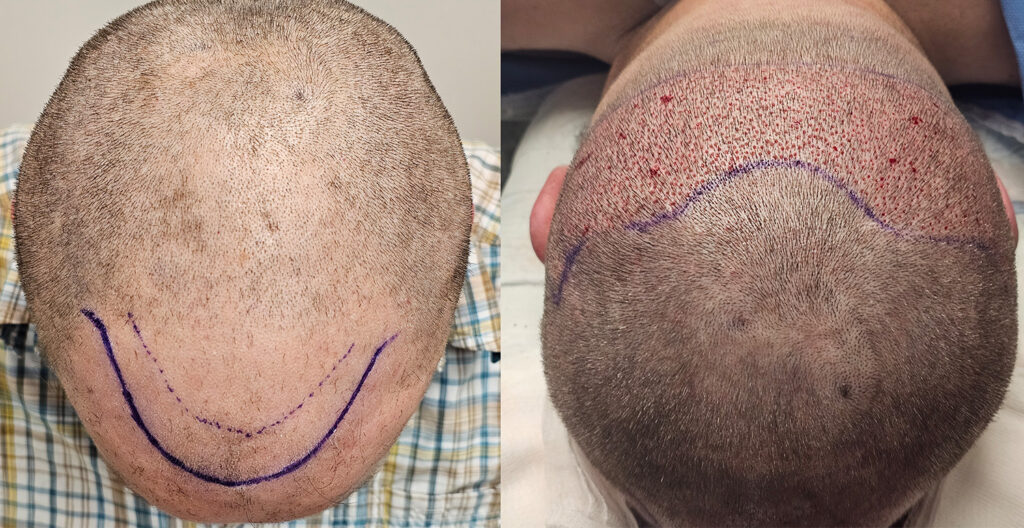
Recipient area with hairline marked out and donor area after FUE harvest.
Two techniques are available: FUE (follicular unit excision), in which individual grafts are extracted one by one using a sub-millimeter punch tool, and FUT (follicular unit transplantation, or strip method), in which a strip of donor tissue is excised and dissected into individual grafts. Each has distinct advantages. FUE avoids a linear scar but requires shaving the donor area and yields approximately 6,000 lifetime grafts. FUT preserves more grafts from the ideal central donor zone (potentially 9,000+ lifetime grafts when combined with subsequent FUE), does not require shaving, and the resulting linear scar is effectively invisible in patients who wear their hair at any length beyond a close buzz.
The right technique depends on the patient’s degree of loss, hair characteristics, styling preferences, and anticipated future needs. A surgeon who can perform and counsel on both techniques — rather than defaulting to one — is essential for creating a long-term surgical plan. If your surgeon only offers FUE, get a second opinion.
Common Myths
“Hair loss comes from your mother’s side.” Androgenetic alopecia is polygenic — it involves multiple genes inherited from both parents. While the androgen receptor gene is on the X chromosome (inherited from the mother), other contributing genes are autosomal. Looking only at your maternal grandfather is an incomplete predictor.
“Finasteride will ruin your sex life.” The internet has amplified legitimate but statistically uncommon side effects into near-universal certainty. In controlled studies, the incidence of sexual side effects with finasteride is approximately 2% in the first year and drops below 1% with continued use. These effects are reversible with discontinuation. Many men have been frightened away from an effective, well-studied medication by anecdotal online accounts that do not reflect the clinical data.
“Just shave it — it’s the only real option.” Shaving is a perfectly valid personal choice, but it is not the only option, and framing it as such dismisses effective medical and surgical treatments that have decades of evidence behind them. If you want to treat your hair loss, real solutions exist.
“It’s too early to treat” or “It’s too late.” It is almost never too early to start monitoring and considering preventive therapy, and it is rarely too late to benefit from some form of treatment — medical, regenerative, or surgical. The optimal strategy depends on where you are now and where the trajectory is heading.
Next Steps
If you are noticing thinning at the temples, crown, or along your part — or if you have been watching your hair change for years and are ready to act — a comprehensive evaluation is the starting point. At Hair Medicine Institute, every consultation includes dermoscopic scalp analysis, a full medical and family history review, and a candid discussion about what is realistic for your specific pattern and goals. Dr. Hawkins is the only dermatologist in Georgia who is also fellowship-trained in hair restoration surgery, which means diagnosis and the full spectrum of treatment — medical, regenerative, and surgical — are available under one roof.