
Why Oral Combination Therapy Works for Women’s Hair Loss
A 64-Year-Old Patient's Year of Hair Regrowth
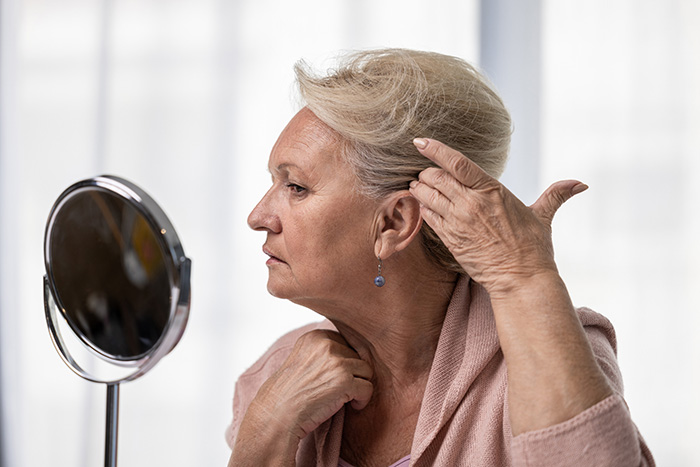
When a woman is referred to Dr. Hawkins at the Hair Medicine Institute with concerns about thinning hair, one of the most common — and often under-recognized — presentations is frontal thinning in women over 50. It is the kind of hair loss that's distressing not because it's dramatic, but because it is visible: the hairline along the temples and forehead becomes sparse, the scalp starts showing through at the part, and patients begin adjusting their hairstyle to hide it. One of my recent patients told me she had started reaching for eye shadow in the morning to camouflage the bare patches near her hairline.
This is her story — and the clinical reasoning behind her result.
The Patient's Experience, In Her Words
Earlier this year, a 64-year-old woman came to see me with thinning along her frontal hairline that had progressed quickly over the preceding months. After six months on a tailored oral regimen, she began to notice meaningful regrowth. By her one-year follow-up, the change was striking — to her, and on standardized clinical photography.
Her own description of the experience:
"In early 2025, my hair began exhibiting signs of thinning around the facial area, prompting concern due to noticeable large patches. To mitigate the appearance of bare spots, I resorted to applying eye shadow as a temporary solution. However, I soon realized the need to schedule a consultation, as the situation had become untenable. Following the initiation of treatment, I began to notice improvements after the first six months. Now, approaching a year of treatment, the results are nothing short of remarkable. Hair thinning is a treatable condition... I sought treatment early and have achieved positive outcomes."
We're sharing her story — with her permission and her photographs — because her experience is far more common than most women realize, and the treatment that worked for her is something many women in her demographic have never been offered.
Why Female Hair Loss Is Underdiagnosed — and Undertreated
By age 65, the majority of women experience some degree of female pattern hair loss (FPHL), often accelerated by the hormonal shifts of menopause. Yet it remains underdiagnosed for two reasons.
First, it is frequently dismissed as a cosmetic issue rather than a medical condition. It is, in fact, a chronic medical condition with well-characterized pathophysiology: androgens — primarily dihydrotestosterone, or DHT — progressively miniaturize susceptible hair follicles over time. Each affected follicle produces a progressively finer, shorter, less pigmented hair until it ultimately stops cycling altogether.
Second, the treatments most commonly recommended to women —
Twice-daily topical minoxidil, applied to a dry scalp with greasy or sticky vehicles
— have poor real-world adherence. Many women try them for a few months, see modest results, and stop. The treatment isn't failing them. The delivery is.
The Case for Oral Combination Therapy
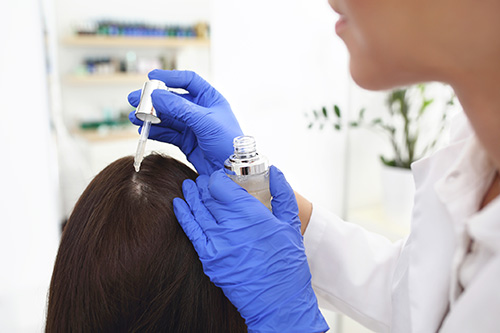
The regimen my patient received was a single compounded capsule containing low-dose oral minoxidil (1.25 mg) and dutasteride (0.5 mg), taken once daily. Here is why this combination has become a cornerstone of how I treat appropriately selected female patients.
Low-dose oral minoxidil has emerged over the past several years as one of the most important advances in medical hair loss therapy. At doses ranging from 0.25 mg to 2.5 mg daily — well below the cardiovascular doses for which the medication was originally developed — oral minoxidil delivers the same vasodilatory and hair-cycle-prolonging effects as the topical version, without the daily application burden, the scalp irritation, or the unwanted facial hair growth that can occur from topical drift. The evidence base in women, particularly postmenopausal women, has grown substantially.
Dutasteride is a more complete inhibitor of DHT than finasteride, blocking both the type 1 and type 2 isoenzymes of 5-alpha reductase rather than only type 2. It is used off-label in women, and candidacy is restricted to postmenopausal patients or those with reliable contraception, because it is teratogenic and must not be used in women who could become pregnant. Within that appropriate candidate group, dutasteride has demonstrated superior efficacy to finasteride in head-to-head comparisons, and emerging evidence supports its role in women with androgen-driven hair loss.
Compounding both into a single capsule is not a small detail. Adherence is the single largest determinant of whether a hair loss regimen works. Patients who have to take two separate pills — or, worse, one pill and one topical — are measurably less consistent than patients who take a single capsule with their morning coffee. Consistency over twelve months is the actual mechanism of action.
What Realistic Timelines Look Like
Hair grows slowly. Biology cannot be rushed. A reasonable expectation looks roughly like this:
- Months 0–3. Stabilization. Shedding slows. Some patients notice a temporary increase in shedding around month 2 as miniaturized hairs are pushed out by new growth in the follicle below them. This is a sign treatment is working, not failing.
- Months 3–6. First visible improvements. Density at the part begins to look fuller. Hairline regrowth becomes apparent, particularly at the temples.
- Months 6–12. The substantial result. By the one-year mark, most appropriately selected patients see meaningful clinical regrowth and a visible reduction in scalp visibility through the hair.
- Beyond 12 months. Maintenance. The benefit is preserved only as long as treatment continues.
This patient's clinical course tracked almost exactly along this curve, which is what we'd expect and what we plan around when we set patient expectations at the consultation.
Why Earlier Is Better
Two points from her review deserve emphasis. The first: hair thinning is a treatable condition. The second: I sought treatment early.
Both matter. Hair loss is genuinely treatable in 2026 — far more so than it was a decade ago — but earlier intervention produces better results. This is not because late-stage hair loss is hopeless. It is because regrowing a follicle that has already been miniaturized for years is biologically harder than preventing miniaturization in the first place. The follicles you have today are the follicles we have to work with. Every year of progression makes the eventual result a little less dramatic.
If you've started noticing more scalp visibility, a widening part, a thinning hairline, or hair that no longer styles the way it used to — that is worth a conversation, not a wait-and-see year.
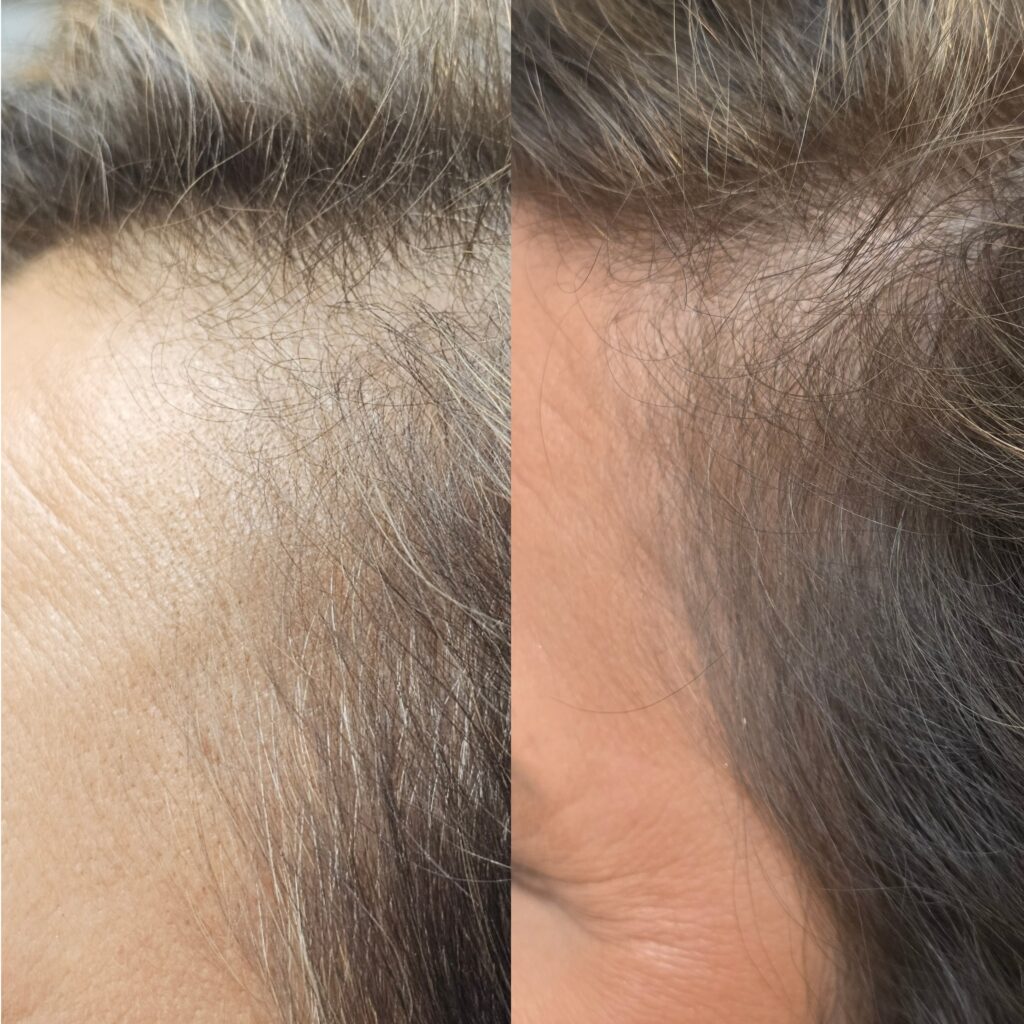
Left temporal view. This is baseline and after 1 year of therapy.
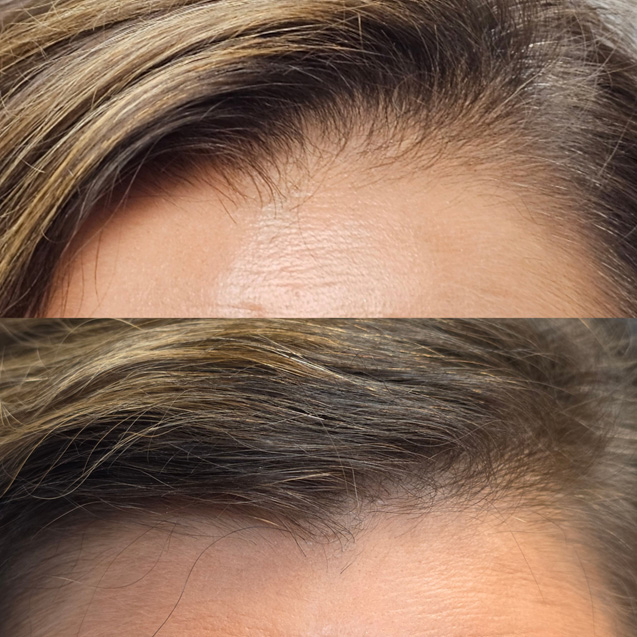
Front view - Top baseline and later, after 1 year of therapy.
A Note on This Treatment
Oral minoxidil and dutasteride are prescription medications with specific candidacy criteria, contraindications, and monitoring requirements. Dutasteride is not appropriate for women of reproductive potential. Both medications require a thorough medical history, examination, and informed consent before initiation. This post is intended to share a clinical experience and educate, not to substitute for an individualized consultation.
If you are a woman experiencing hair thinning and would like to discuss whether medical treatment is right for you, Dr. Hawkins would welcome the opportunity to evaluate you in our Alpharetta clinic.
Spencer Hawkins, MD Board-Certified Dermatologist · Mohs Surgeon · ISHRS Fellowship-Trained Hair Restoration Surgeon Hair Medicine Institute · Alpharetta, GA