
The Hair Growth Cycle
Why Hair Cycles Matter
Every treatment timeline in hair medicine — from minoxidil to hair transplantation — is governed by the hair cycle. Understanding these phases is key to why hair loss treatments take months to show results, why shedding can be a sign that treatment is working, and why consistency matters more than any single intervention.
The Four Phases
Anagen: The Growth Phase
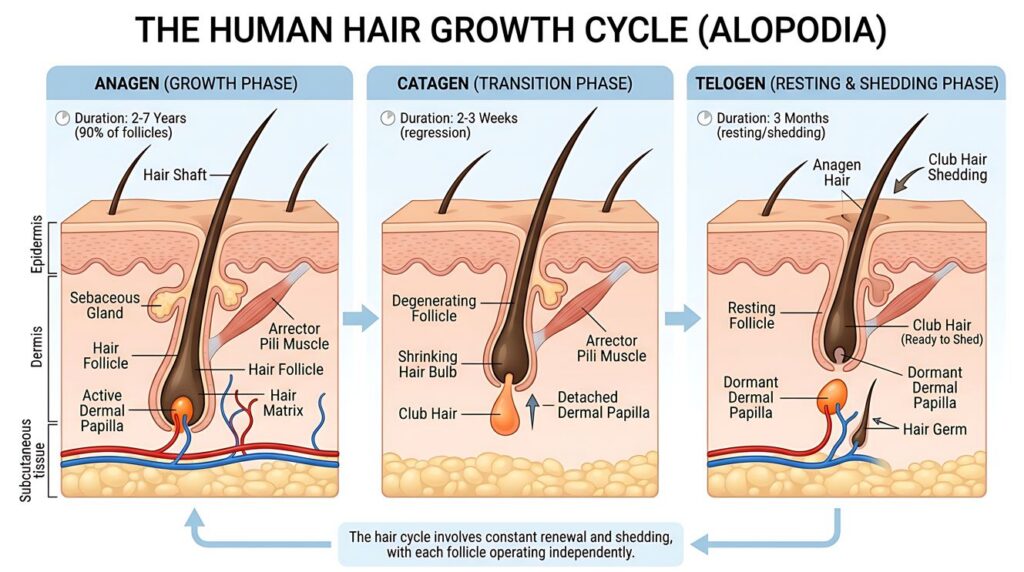
Anagen is the active growth phase, during which the hair matrix cells rapidly divide and the hair shaft elongates. On the scalp, anagen lasts anywhere from 3 to 7 years — this is the primary determinant of maximum hair length. Someone who "can't grow their hair past their shoulders" likely has a shorter anagen phase, not slower hair growth.
During anagen, the follicle is deeply embedded in the subcutaneous fat, the dermal papilla is large and well-vascularized, and the hair being produced is thick and pigmented. Approximately 85–90% of scalp hairs are in anagen at any given time.
Catagen: The Transition Phase
Catagen is a brief regression phase lasting roughly 2–3 weeks. The lower portion of the follicle undergoes programmed cell death (apoptosis), the hair detaches from the dermal papilla, and the follicle shrinks upward toward the skin surface. This is a tightly regulated process — it signals the end of the current growth cycle without damaging the stem cells needed for the next one.
Telogen: The Resting Phase
Telogen lasts approximately 2–3 months. The follicle is dormant, the hair (now called a club hair because of its bulbous root end) remains loosely anchored in the follicle, and the dermal papilla rests near the bulge stem cell region, preparing to initiate the next anagen phase.
About 10–15% of scalp hairs are in telogen at any time.
Exogen: The Shedding Phase
Exogen is the active release of the club hair from the follicle, distinct from telogen itself. This is when the hair actually falls out — during brushing, washing, or simply from daily activity.
Normal exogen shedding is 50–100 hairs per day. When this number increases dramatically, as in telogen effluvium, it is because a disproportionate number of hairs entered telogen simultaneously.
Mosaic Growth: Why Not All Hairs Cycle Together
Scalp hairs cycle asynchronously — each follicle operates on its own independent clock. This is why healthy hair maintains relatively even density: at any moment, the vast majority of hairs are in various stages of growth, not shedding. In conditions like telogen effluvium, a systemic shock synchronizes a large cohort of follicles into telogen simultaneously, overriding this normal mosaic pattern and producing visible thinning.
Miniaturization: The Hair Cycle in Androgenetic Alopecia
In androgenetic alopecia, the fundamental problem is a progressive shortening of the anagen phase. With each successive hair cycle, the growth phase gets a little shorter. Because anagen duration determines hair length and thickness, each new hair produced is thinner, shorter, and lighter than the last. Over many cycles, a thick terminal hair transitions to a thin, nearly invisible vellus hair — and eventually, the follicle may stop producing visible hair altogether.
This is why early intervention is so important. Medications like dutasteride and finasteride work by blocking the hormonal signal (DHT) that drives anagen shortening. Minoxidil works by prolonging anagen directly. The earlier these are started — while the follicles are still producing some hair — the more follicles can be preserved and, in some cases, partially reversed.
What the Hair Cycle Means for Treatment Timelines
One of the most common frustrations patients express is the time it takes to see results from treatment. This is not a failure of the medication — it is a consequence of the hair cycle itself.
When a medication pushes a resting follicle back into anagen, the new hair still needs to grow from scratch. At roughly half an inch per month, it takes 3–4 months before the new growth is even visible, and 6–12 months before the cumulative effect is cosmetically meaningful. Some patients experience an initial "shed" in the first few weeks of treatment — particularly with minoxidil — as weakened telogen hairs are pushed out to make room for new, healthier growth. This is a good sign, not a reason to stop.

Next Steps
The hair cycle is the biological clock that governs every aspect of hair growth and hair loss treatment. Understanding its phases helps set realistic expectations and reinforces the importance of patience and consistency. If you are considering treatment — or if you have been on treatment and are wondering whether it is working — a detailed evaluation can assess where your follicles are in the cycle and whether your current approach is on track.